Phoenix by Lake Merced

When I think of the housing bust, I picture tract housing on the edges of cities like Phoenix, the kind of places where half the houses are in foreclosure, promised amenities never get built, and the remaining homeowners struggle to hang on in an area without jobs .  We’ve done a pretty good job of dodging that bullet here in San Francisco.

But out by Lake Merced there’s a sad example of the cost of the “irrational exuberance” that led to the housing debacle: Parkmerced.   Actually, Park Merced is a great icon of two historic follies. It was built for drivers, isolated from shops and jobs. At 28 units per acre it’s about half as dense as the city’s average. And now the owners are joining legions of less-sophisticated homeowners into default.

For many of the homeowners in default, their original plan made sense. They wanted, in many cases, a home for the family in a safe neighborhood. The American Dream.  A lender assured them that they could handle the costs and that the value would keep going up.  Don’t worry about the small print.

Parkmerced’s story is similar to that of two other enormous properties, these in Manhattan.  For $5.4 billion (the largest  real estate deal  ever for a property), Tishman Speyer bought Stuyvesant Town and Peter Cooper Village. Estimated value today: $1.9 billion.  Poof:  $3.5 billion up in smoke. Half a billion has been written off by Calpers, the pension fund for California workers.

These 80- acres of buildings, with over 11,000 apartments, are a huge part of Manhattan’s middle-class housing stock.  My cousins, a schoolteacher and an editor, lived there.  Tishman Speyer’s plan, according to the New York Times: “replace rent-regulated residents with tenants willing to pay higher market-rate rents”.  And they had to: rents covered less than one third of the debt service on the loan.  Of course, they lost the buildings.

We’ll see how the Parkmerced saga unwinds. The owners, Stellar Management are in default on a $550 million mortgage.   It would be a shame if their plan to increase density and sustainability gets lost in the wreckage.  Fortunately, existing tenants are protected from becoming collateral damage of this speculation.

The homeowner who got in over his or head and is now underwater is nothing like the brains who got Calpers and the other lenders into this pickle.   He or she is probably not very well educated, young, and naïve. Many of them lost jobs in construction, building homes like their own for the buyers who never came.

But Tishman Speyer and the owners of Parkmerced, Stellar Management, are highly educated, savvy in the fantasy world of spreadsheets, as are the loan underwriters at Calpers and the banks.  This is what they do for a living.

They should have known better. Or cared more.

Fond memories of Harvey Milk

Tomorrow is Harvey Milk Day here in California. It would have been his 80th birthday.

From 2010, it’s hard to remember how different San Francisco was then. We didn’t yet see the graphic reminders of AIDS on every bus and, in some neighborhoods, every street – the skeletal men with red blotches on their faces. People’s Temple was a respected political army, until their utopian experiment ended so tragically in the jungle of Guyana. San Francisco hadn’t yet lost a certain innocence.

We didn’t have rent control yet, and when I spoke to a reporter about a rent increase (affecting an elderly Irish-American couple on Dolores Street, both with cancer) I was suspended from my job at the Human Rights Commission. Harvey championed me:

Harvey’s resolution against ‘gag orders”

I recall when I would visit Harvey in his City Hall office. In the small anteroom, he papered the walls with hate mail that he received: really vile threatening letters. He was under siege. But at least at the time he felt close to Dan White, another outsider on the Board.

I mostly worked with Harvey on legislation which would impose a new tax on housing speculators. We even produced this leaflet in support of the legislation:

This at a time when a house in a good neighborhood in San Francisco cost $30,000. Some things in this city have gotten worse. But a lot has improved. We have rent control. Plans are in place to prevent Downtown from wiping out the Tenderloin and Chinatown and to prevent any more International Hotel evictions. Friends I thought would be long gone from AIDS are living healthy lives.

One last memory of Harvey, my most vivid recollection.

At a meeting in the back of his camera store someone referred to a man as “mentally unbalanced”. Harvey started laughing:  “Balanced? Who’s balanced? You think I’m balanced?” And he laughed so hard he slid off the couch onto the floor. We watched our new Supervisor, in hysterics on the floor at the idea that anyone would mistake him for “balanced”.

To you, a happy Harvey Milk Day

Chicago celebrates planning and architecture like no place else.

The Architectural Foundation has 400 volunteer docents leading tours crisscrossing the city on land and water. I took two of the tours last week.

From Louis Sullivan to Mies van der Rohe to Frank Lloyd Wright to Renzo Piano, this is the place.

When the public library launched its “One Book One Chicago” campaign it picked “The Plan of Chicago: Daniel Burnham and the Remaking of the American City”.

What was the idea of these plans? Here’s how some panels at the Architectural Foundation tell it:

But can an urban plan really bring order out of chaos? You’d have to be Albert Speer to believe that.

Planning and architecture are part of it, but cities’ problems are as readily addressed as economic, cultural, public safety, environmental and educational challenges. It’s complicated.

And sometimes the results are small and surprising. At the corner of Castro and 18th, this makeshift memorial salutes a beat cop who passed away last week. I was touched by this note:

Thanks for getting me off the street. You will be missed.

Sometimes it’s the human touch, one person caring about another, that can best address chaos.

Form Foils Function reposted by Planetizen

Here’s a piece I wrote on the myth of public participation in planning decisions here in San Francisco.

As soon as Planetizen posted it I got an email from the “Supervisor of Public Consultation, City of Toronto” to tell me that it is the same there.  I wonder if there is a good working model for bringing the real public into city planning – and what kind of city results from it.

http://www.spur.org/publications/library/article/formfoilsfunction01012007

1 impression of Buenos Aires

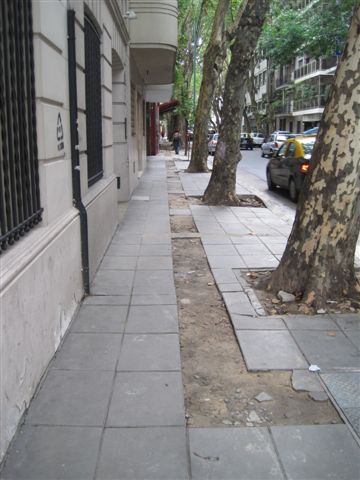
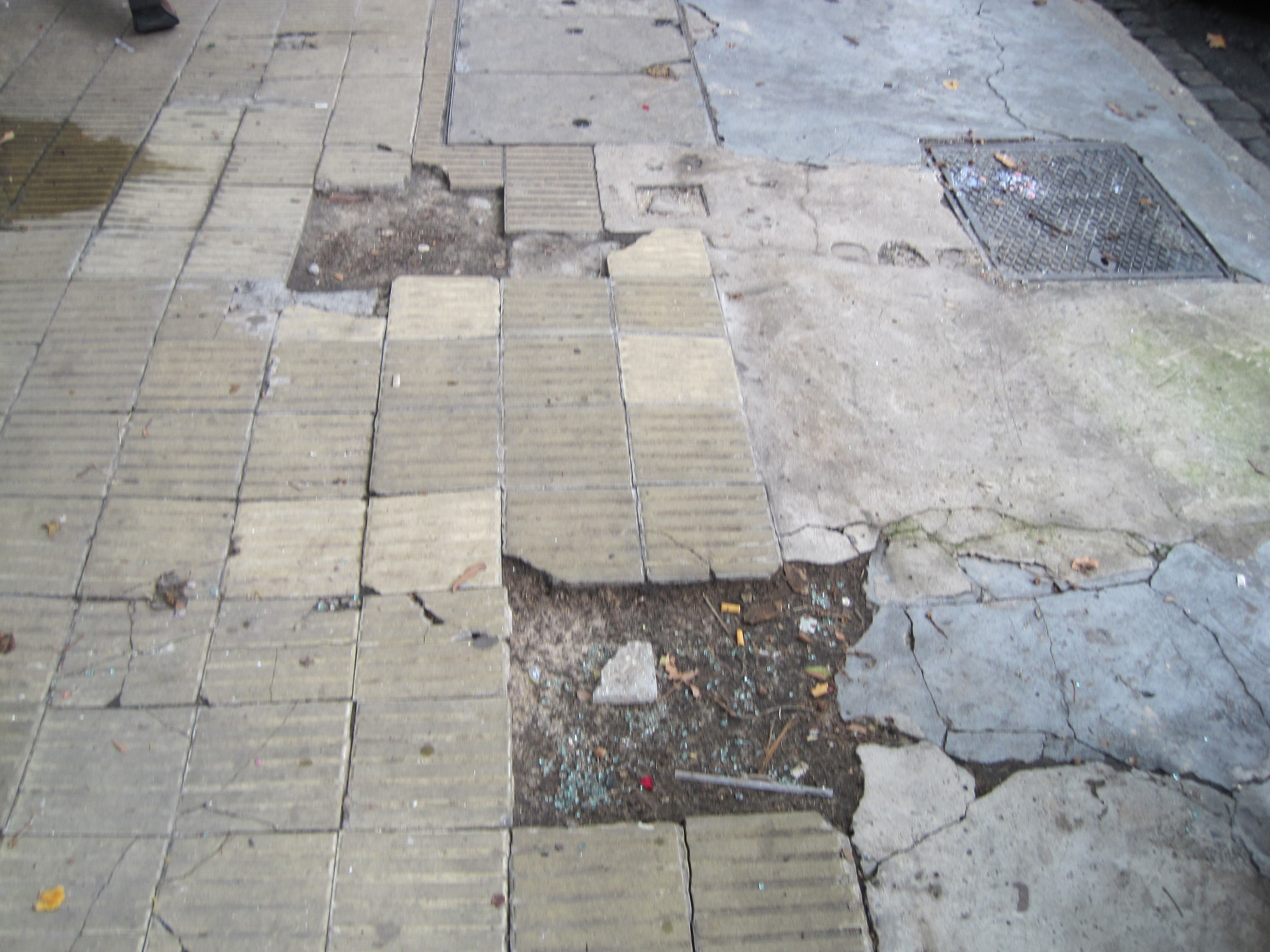
Why are the sidewalks in Buenos Aires so messed up?

Not in the swanky neighborhood of Recoleta, but in most neighborhoodsa sidewalk is an obstacle course. Not even including the dog shit.

Each property owner seems to be responsible for the pavers in front of his or her building, so every thirty feet or so there is a different material in a different pattern. But each patch has gaping holes.  Maybe the different tiles bash up against each other.  Or maybe they don’t lay enough drainage under them. I wondered if crews come out at night to trash the sidewalks so that crews can be hired during the day to fix them.  Here’s a theory from a cynical friend: people don’t sue each other enough.  An Argentine acquaintance said it’s “corruption”.  But you can have plenty of corruption and decent sidewalks.

A mystery.

Another mystery

Frequently Asked Questions About Frederick J. Kiesler

frequently asked questions about frederick j. kiesler
You may not have any questions about Frederick J. Kiesler and probably you never heard of him.  But this link will take you to what you should know about him.

I wrote this and hope you enjoy it.  Any more questions, just let me know.

Habitat

In the past year or so, I’ve been to Paris, Barcelona, New York, Montreal, and Buenos Aires. In two weeks, Chicago.

I’ll be posting impressions on upcoming posts.  For today, Habitat.

I’d first seen it at the time it was built, for the Expo 67 World’s Fair.  It turned out to be another example of World’s Fairs glimpses of a future that never came around.  Like something from Sleeper.  But it thrilled me at the time.

Now, not so much. On an island, separated from the City by industry and shipping, car-reliant. The critical mass originally planned to make it more of a self-contained community never happened.  A World Heritage Site, it sits isolated.