A HANDFUL OF EROTIC HOTSPOTS OF MARKET STREET

A couple of times a week I walk from my house to my office at Second and Market Streets and of course there’s only one way to go: down Market Street.

You could write a little essay about the hidden erotic aspects of Market Street, but why be coy? There’s nothing hidden about it. It’s right out there.

That’s what Market Street is about. From the Castro to the spike of the Ferry Building filling the canyon between the highrises, with the neon of mid-Market and the hustle of the financial district in between, Market Street is sexy.

All it needs is barkers like the strip clubs on Broadway yelling “Check it out!”

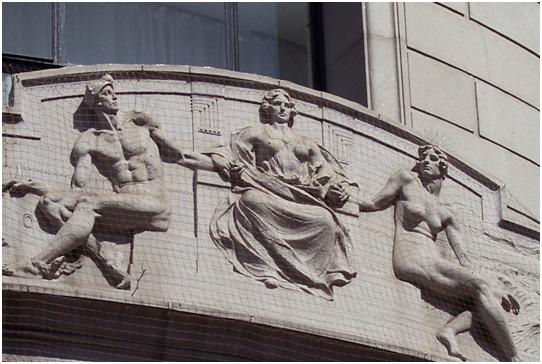
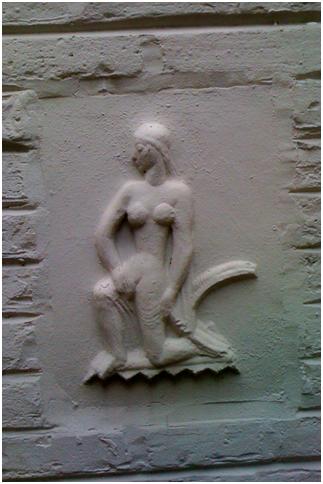
Sometimes it’s the advertising signs, or the statues, or the names, or even elements of the architecture. Today it’s gaudy and commercial, but topless men and women were at one time heroes – stuck on or holding up buildings.

Whatever you’re into, come find it on Market Street.


And on Market Street there is the loyal opposition, too:


2 Buildings About Power and 1 About Love

“It might be more romantic to say “I love you” in French than it is in Cantonese; nevertheless, it is still possible to say it. It might be more touching to say it in song than in design, but saying it in design should be achievable, too.

And it is possible to say “I love you” even in architecture, as the Taj Mahal proves.”

Stefan Sagmeister, “Things I Have Learned In My Life So Far”


Some buildings have something to say. It might be a bank building saying “your money is safe in here” or a highrise saying ‘we mean business”. A house could telegraph modest comfort or shout out wealth.

Here are two buildings that tell you about different kinds of power.


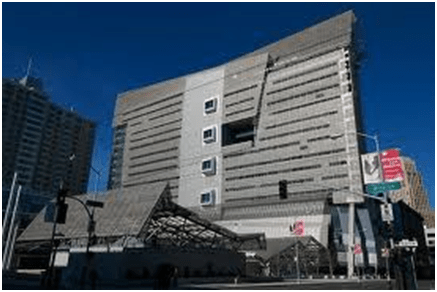
Here’s the Federal office building in San Francisco.

I think it says “I’m in charge here. You are nothing.”


This is the power plant at Kennedy Airport. It glows at night and usually there’s steam coming out of the pipes.

These are buildings with clear messages. They’re like words. String buildings together on a block and you might get a sentence, in a neighborhood maybe a paragraph. And when they click it’s poetry.


Something Happened Here

Everyone knows there are invisible cities. Sure, there are the obvious one with street corners and steps and shopfronts. But then there are the spots and the patterns only some people know.

Somehow drug people know that the corner of Church St. and Market St. works well for them.

Johns know where to find hookers to their particular tastes.

Gang members know where they can safely go and where they can’t.

Cops know where they can pick off speeders.

And there are the cities that live only in memory. When I go to neighborhoods I lived in I can feel the ghosts, remember the parties.

Out my office window now I overlook where I flew off a motorcycle and broke my collarbone, about 25 years ago. Nobody would know but me.


In front of my old apartment in North Beach an old man, Peter Macchiarini, once showed me where he was standing when he heard about the bombing of Pearl Harbor, and he told me the curse he’d said. To this day when I walk by that spot I too remember Pearl Harbor and I remember Peter.

Here’s a spot with a past: A banal parking lot for a banal apartment complex in Berlin.


Underneath: the site of the bunker where Adolph Hitler hid for the last two weeks of the war before marrying Eva Braun and killing himself.

Under our feet, a world of wonders.

“Is it possible, after all, that in spite of bricks and shaven faces this world we live in is brimmed with wonders, and I and all mankind, beneath our garbs of commonplaceness, conceal enigmas that the stars themselves, and perhaps the seraphim, cannot resolve?”

Herman Melville, Pierre, 1852


Remembering the International Hotel

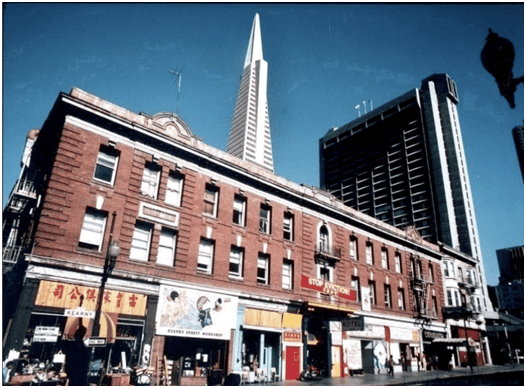
The International Hotel stood at the corner of Kearny and Jackson and it was the center of a community that no longer exists: Manilatown. Manilatown came down with the Hotel, after the Sheriff cleared the building’s elderly Filipino tenants in a dawn raid on August 4, 1977. I was there, inside the Hotel, representing the City’s Human Rights Commission.


We lost that battle. But it couldn’t happen today.

Here’s what I said about it in a recent KALW radio show on the International Hotel:

I think we’re a more compassionate city as a result of what happened there. I think the boundaries of discussion of what property owners can do has really shifted. And we’re much more comfortable requiring developers to include affordable housing, saying you have to save residential hotels. And understanding, I think, the value of preserving Chinatown, preserving parts of South of Market, preserving parts of the Western Addition, and not just letting private or public redevelopment run roughshod.

Obviously we didn’t succeed in our goal of preventing the eviction and saving the building, but the legacy of the International Hotel is that it couldn’t happen again. And maybe it took that kind of shock, the image of elderly people being let out at dawn. The sheriff smashing down their doors. The cops on horseback charging into the crowds. Maybe it took those images to really understand what was at stake here. We lost the hotel, we lost the battle, but it’s not going to happen again.

If you’d like to hear the show, or just read the transcript, you could click here.


A Valentine to Rockefeller Center


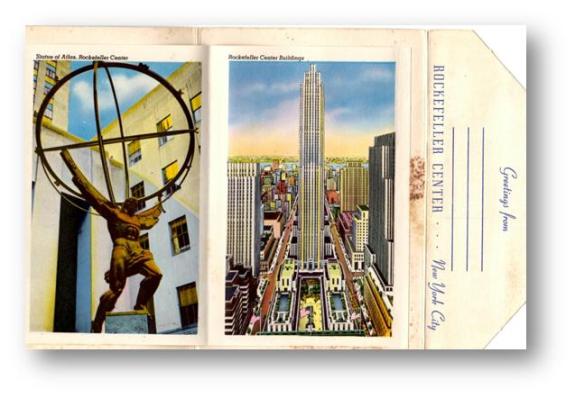
Even as a kid, Rockefeller Center thrilled me and it still does. It seemed to me the center of the civilized world: the swanky Rainbow Room, the deco design of the towers which reached to the sky, the skaters in front of the Prometheus statue, the dressed-up office workers and shoppers, even the subterranean shopping arcades. It was a chance to brush up against the Mad Man world of the ’60s and ’70s.

But I wonder how it came about.

What would be the response to such a proposal today?

At a used bookstore I came across this:


Nelson Rockefeller calls it “A story of Planning and Building”. But it’s also a story of the promise of a new technology, of optimism and of fear, of destruction and rebirth. It’s a relic of another time and of other attitudes toward the city.

Rockefeller Center was built during the Depression and when the war in Europe had begun. The project began during a boom time. Nelson Rockefeller, in his remarks at the ceremony when the last rivet was driven: “It’s a little difficult to recapture the flamboyant spirit of that era, when everything was going up and up: stock market, business, hopes, expectations, schemes, projects, everything”. Then came the Depression – “the crash and the collapse. Everything was changed.”

John D. Rockefeller had bought the site – three city blocks full of tenements and speakeasies – with plans to demolish them for a new home for the Metropolitan Opera. 228 brownstones, with 5,000 tenants and an estimated 1,000 speakeasies, came down.

Here’s how the French newspaper Le Jour described the scene in an article dated August 19, 1934: “A sort of Montmartre, populated by artists, writers, journalists, that is, men of vivid imagination, little money, and great optimism.”(Of course many women lived in the district as well and many of them lived in bordellos.)
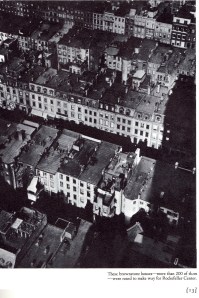

Imagine if today the family of an oil tycoon bought up a neighborhood, evicted thousands of people, demolished hundreds of brownstones, and built office towers. Those days are over. Here in San Francisco, the Rockefellers duplicated their NY success with the Embarcadero Center, but displaced only the wholesale produce market.

Back to New York. The Opera decided to stay put, and Rockefeller now owned a neighborhood. Or, more specifically, Columbia University owned the site, as it still does, with a ground lease held by the Rockefellers.

Fortunately for the Rockefellers, a new technology came along to serve as the economic engine of the project. Radio: the dotcom of the day.

Nelson Rockefeller, again: “The answer was – radio. Opera was the great old art; radio the new – the latest thing in this contemporary world of ours, the newest miracle of this scientific era, young and expanding.” So RCA, Radio Corporation of America became the anchor of the project.

David Sarnoff, president of RCA, saw more miracles to come: “And to this modern means of carrying sound through the air there is now being added the miracle of sight. Someday, we hope, television may enable everyone, everywhere, to see the handiwork of man.”

The Last Rivet, the commemorative program for the opening of Rockefeller Center, is a collection of speeches given on that day and it touches not only on quaint concepts like Growth and Art and Progress but also on war and peace. Specifically peace between Capital and Labor, but also about the war clouds in Europe. John D. Rockefeller: “The business men of this country want peace, peace among themselves, peace with government, peace with labor. They are tired, and the public is tired, of strife and discord, doubt and uncertainty, at home and abroad. They yearn for peace.”

Rockefeller Center: worth the bother? I admit it’s a silly question. First because Rockefeller Center exists and it’s too late to ask it.

But also because, as with any project, there were winners and losers. Columbia University is winning to this day. So is the City of New York (according to Mayor LaGuardia, in his remarks, the assessed value of the site jumped from $32 million in 1928 to $86 million on opening day. 20 years ago that was $1.6 billion.)

Sure there was displacement and buildings came down. Those buildings look “historic” in old photographs but most of them were less than fifty years old. A raffish enclave was lost, with its bars and whorehouses.

The small businesses really made out. A contemporary observer wrote “If there is one thing calculated to bring tears of joy to the eyes of a small business man, it is to hold a lease on a piece of property which is being assembled by John D. Rockefeller, Jr.”

And there was controversy about the design. Of all the people who hated the plans for Rockefeller Center–and almost everyone did–none hated them more than Lewis Mumford, writing in the New Yorker.
He assaulted its “absence of scale,” its promotion of “super-congestion,” even a perceived moral turpitude evidenced by its “failure to recognize civic obligations. … If Radio City is the best our architects can do with freedom,” Mumford thundered, “They deserve to remain in chains.”

Many of my friends would be at the barricades against such a proposal today.

Me, I agree with The Last Rivet:

“Rockefeller Center is more than a triumph of architecture. It is a triumph of the human will. It passes on to future generations the heritage of our nation’s pioneers. It expresses the modern age. It is a living symbol of the spirit of America.”
The best corner to get clean

Here at Market and Montgomery Streets the docents meet their groups by the Spirit of the West statue and troop them around Downtown. Here’s what they probably don’t know: it’s a terrific place to clean yourself. Not in any fountain. Not in the sense we usually think of as cleaning. It’s something else.

The Bay Citizen ran a piece recently about a Ponzi schemer in North Beach. He uses the name Giuseppi Viola sometimes and his bank knows him as Ralph Napolitano. (Ralph himself has disappeared.) His real name is Joseph Viola, he was a fugitive, and he preyed on people who wanted 20% returns on their investments.

Anyway, a private investigator named Tim Schmolder was hired to tail Viola to learn where he lives. According to his client, “Good surveillance men are rarer than diamonds. I’ve only known three or four in 40 years.” Schmolder fits the bill.

Schmolder: “This guy was pretty clever making sure that whenever he does head home, no one is trailing him: ‘Cleaning himself’, that’s what we call it. That’s what you have to do, the life you have to live, if you are on the run.”
Schmolder thinks it was no accident that Viola chose that particular spot. “There’s no better intersection in San Francisco to clean yourself than that intersection,” Schmolder says. You can take BART, go underground, go down long corridors in hotels into alleyways, catch a taxicab. Everything is spontaneous.”

Come to think of it, maybe that’s why it’s such a great intersection: the sheer number of places to duck into.

And maybe half the people I see there, under my office window, are tailing the other halve, who are trying to get clean. I’m pretty sure that the swells at the three shoe shine stands are neither following nor evading tails. Everyone else, who knows?

Woodblock print by David Prowler


AN APPRECIATION OF THINGS STUCK ON, HANGING OFF, STUCK THROUGH, AND PLACED ON TOP OF BUILDINGS

There is a lot to read about buildings. From time to time I write about them on this blog. That’s not what this about.

This time, I’d like to pay some attention to things stuck on, stuck through, hanging off, and stuck on top of buildings.

Like these:


STUCK ON:


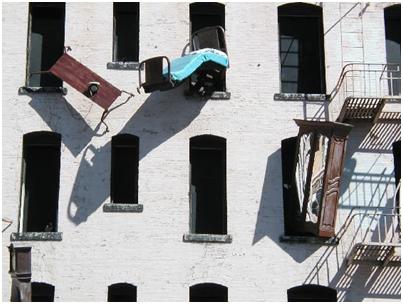
This stuff has been hanging off the abandoned Hugo Hotel, South of Market, forever it seems.


Flax art supply store, Market Street


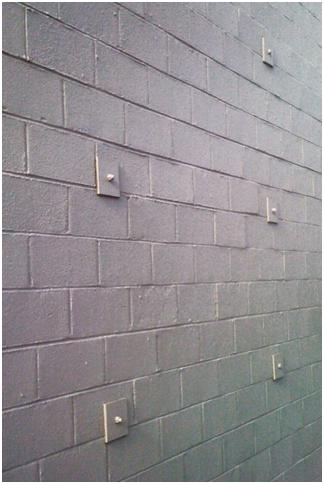
STUCK THROUGH:


For seismic reinforcement.


STUCK ON TOP:


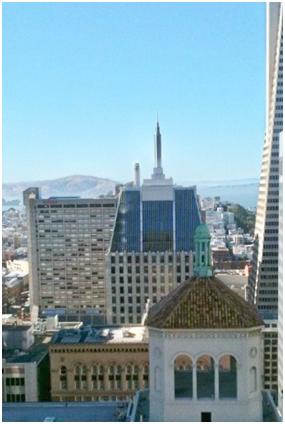
If you’ve got a stubby building, why not put an elegant, slender one on the roof?

(505 Montgomery, SF, photo by Steve Vettel)


BUILDING ON THE SIDE:


Or you could put a really handsome bank on the side of a bank.


    A LITTLE INTEREST, STUCK ON:


PATTERN, STUCK IN:


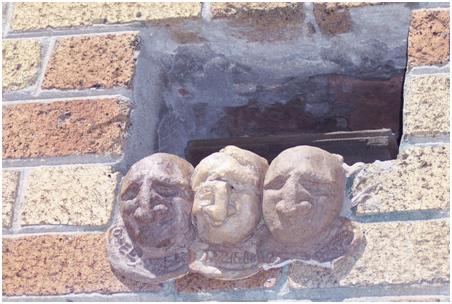
HEADS, STUCK ON:


HOW ABOUT A NICE OWL ON TOP?


This owl is in Barcelona. To the left, Gaudi’s Sagrada Familia.


STUCK ON, PARTS OF OTHER BUILDINGS:


For parts of other buildings stuck on a building, you can’t beat the Tribune Tower in Chicago.

As the brochure in the lobby tells it:

“Studding the Tower’s limestone exterior are more than 150 carefully selected stones and artifacts from around the world. Visitors can see fragments of Abraham Lincoln’s original tomb, India’s Taj Mahal, and China’s Forbidden City without leaving downtown Chicago. Some of the Tower’s famous stones are from structures that pre-date the Christian era, such as the great Pyramid of Cheops in Egypt. Others like the Berlin Wall, recall historic events of the 2 0th Century. Still others are associated with notable persons including George Washington, Napoleon Bonaparte, and Mark Twain.”

To top it off, the Tribune Tower has a Gothic cathedral on the roof:


City of Bits

Maybe you’ve heard of William Mitchell, Dean of the School of Architecture and Planning at MIT. I’d never heard of him when I picked up his book, City of Bits, at the Friends of the Library bookstore out at Fort Mason. The book flap caught my eye: “a comprehensive introduction to a new type of city, a largely invisible but increasingly important system of invisible spaces interconnected by the information superhighway”. This interests me, how the city is being changed as we are freed from the demand for proximity. Do we really even need cities anymore, now that we don’t have to come together for business, to meet, to exchange ideas?

Mitchell has some thoughts on these questions:

  • “Your own address is not pinned to a place; it is simply an access code, with some associated storage space, to some computer located somewhere on the net.”
  • “Increasingly, software beats hardware. In the early 1990’s, for example, Columbia University scrapped plans to build a twenty million dollar addition to its law library and instead bought a state of the art supercomputer and embarked on a program of scanning and storing ten thousand deteriorating old books yearly.” [Similarly, here in San Francisco, the Pacific Stock Exchange dropped a proposed new highrise with a trading floor as it dawned on them that nobody needed a trading floor anymore. Now, their former home is a gym.]
  • “Money, too, is now digital information, endlessly circulating in cyberspace.”
  • He writes about how the first department store, Paris’ Bon Marche (1852) displaced small shops and to which “crowds of shoppers swarmed by train, tram, or bus”. In turn, Downtown shopping districts have been brought down in many cities by suburban malls. Now, he writes, “the electronic mall simply short circuits the trip to a concentration of goods and displays, and replaces the glazed display windows facing the street with windows on a computer screen.”

    Does this mean that cities will become obsolete? Some are already, like Detroit, which has a residential vacancy rate of 27.8 percent, up from 10.3 percent just ten years ago. It’s got about as many residents as San Francisco, but spread out over 139 square miles (vs. our 49). The population dropped from 2 million in 1950 to 790,000 today.

    Paul Goldberger, the architect critic for the New Yorker, spoke at SPUR last week and touched on the “obsolescence” of cities. His take: some will become museums, like Venice. But the ones that will thrive will do so because of the strength of their cultures. That makes me optimistic about the future of San Francisco, because culture we’ve got. Not in the museum sense (though we sure have that) but also in the Vietnamese Tenderloin sense and the tattooed lesbian sense and the foodie sense and the chess players on Market Street sense.

    We need the city. Mitchell’s book, City of Bits, I ran across on the shelf in a bookstore. I wasn’t looking for it on line, knew nothing about it or the author. And after I found it I ran into a friend and we sat in the sun, near the Bay, at Fort Mason, and caught up. On line that would be impossible.

    Back to William Mitchell. Turns out he pioneered computer aided design, invented something called the City Car and ran something called the Smart Cities research group at MIT. His take: it’s not the city that’s obsolete, it’s the car, and he spells it out in this interview. Sadly, William J. Mitchell passed away last week, at the age of 65. His obituary in the Times was headlined, “Architect and Urban Visionary”. He lives on, here:


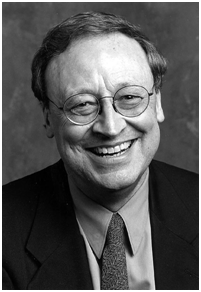
    William J. Mitchell


Revolution of Forms

They say that during the Cuban Missile Crisis, to show their unconcern, Fidel Castro and Che Guevara went golfing for the cameras at the Havana Golf Club. There and then, they decided to turn the course into an art school, featuring schools of theatre, dance, and visual art. The architects planned a revolution of forms (the name of John Loomis’ great book about the experiment http://www.amazon.com/Revolution-Forms-Cubas-Forgotten-Schools/dp/1568981570/ref=sr_1_1?ie=UTF8&s=books&qid=1276031751&sr=8-1)

The Schools’ forms were sinuous, organic, sexy, based on Afro-Carribean villages, winding passageways and Catalan vaults.

But as the Soviets took more control there was a clampdown: the design was too idiosyncratic and not International in style.

In a speech in 1954, called “Remove Shortcomings in Design, Improve Work of Architects”, Nikita Khrushchev had laid it out:

“We have tolerated shortcomings in training architects. Many young architects who have barely crossed the thresholds of the institute and have not yet got properly on their feet follow the example of masters of architecture and wish to design only buildings of an individual character, are in a hurry to build monuments to themselves. Many architects want to create monuments to themselves ‘wrought by human hands’ in the form of buildings built according to individualized designs” [Laughter, applause]

The architects of the Art Schools, Roberto Gotardi (from Venice), Ricardo Porro (Cuban), and Vittorio Garrati (Italian) had made “errors”. They were accused of

  • “individualism”,
  • “monumentalism”,
  • “historicism”,
  • “utopianism”,
  • “formalism”,
  • “grandiloquence”,
  • and being driven by “aesthetic criteria” rather than “socialist rigor”.
  • They were “elitists” and “cultural aristocrats” whose work exhibited their “narcissistic and bourgeois” formation.

    [These and the Khrushchev quotes are from Loomis’ terrific book, Revolution of Forms.]

Work on the schools was halted in 1965. The dance school was 90% complete.

Porro was purged from the Ministry of Construction – “like the removal of certain individuals from photographs”, he said – and he and his family left for Paris.

Garatti was imprisoned for three weeks on charges of espionage and expelled from Cuba.

Only Gotardi remained.

Gotardi says, “We were accused of being individualists and capitalists.” He was pretty much tarred and feathered, stomped on for his architecture. Since his work on the school, he has taught and designed Soviet-style pre-fabricated apartment blocks.

As an Italian he could have left Cuba at any time. But he stayed.

Why would he do that? He had to choose between his love of architecture and his love of the revolution. Or maybe his love of his Cuban wife or of the laid back Caribbean life. Maybe the answer is best expressed in an opera. There’s one in progress, by Robert Wilson. Here’s a clip: http://www.youtube.com/watch?v=QbggbSJY02M.

He said that when he graduated from architecture school he realized that he couldn’t survive in the Capitalist environment. He refused to answer when asked how the Cuban system had worked out for him.

This model is at the Graham Foundation, a mansion in Chicago’s Gold Coast. It shows how the completed school would look.


Felipe Dulzaides’ show there, Utopia Posible, tells the story. Here’s a review from Time Out Chicago: http://chicago.timeout.com/articles/art-design/85519/felipe-dulzaides-at-the-grahan-foundation-art-review

When Felipe and I visited the school in 1999, talking our way past the guard, the jungle had taken over. Here are some pictures I took at the time:


The buildings got more and more rundown until Loomis’ book came to Castro’s attention and the World Heritage Fund took notice. Planning work has started up again – and stopped again. Something about not enough bricks.

If you know a lot of architects you probably know a lot of unemployed architects. Maybe this is a bigger problem in San Francisco than elsewhere because so many architects want to live here. Or maybe it’s worse in other places because there’s even less work. And even the ones with jobs don’t seem that happy: having to please clients and planners and neighbors all the time. Compromising.

I guess, though, that there is some comfort in knowing that the charges that killed the careers in Cuba of Gotardi, Porro and Garratti: individualism, monumentalism, aesthetics, are what make careers here. And we’ve got plenty of bricks.


Phoenix by Lake Merced

When I think of the housing bust, I picture tract housing on the edges of cities like Phoenix, the kind of places where half the houses are in foreclosure, promised amenities never get built, and the remaining homeowners struggle to hang on in an area without jobs .  We’ve done a pretty good job of dodging that bullet here in San Francisco.

But out by Lake Merced there’s a sad example of the cost of the “irrational exuberance” that led to the housing debacle: Parkmerced.   Actually, Park Merced is a great icon of two historic follies. It was built for drivers, isolated from shops and jobs. At 28 units per acre it’s about half as dense as the city’s average. And now the owners are joining legions of less-sophisticated homeowners into default.

For many of the homeowners in default, their original plan made sense. They wanted, in many cases, a home for the family in a safe neighborhood. The American Dream.  A lender assured them that they could handle the costs and that the value would keep going up.  Don’t worry about the small print.

Parkmerced’s story is similar to that of two other enormous properties, these in Manhattan.  For $5.4 billion (the largest  real estate deal  ever for a property), Tishman Speyer bought Stuyvesant Town and Peter Cooper Village. Estimated value today: $1.9 billion.  Poof:  $3.5 billion up in smoke. Half a billion has been written off by Calpers, the pension fund for California workers.

These 80- acres of buildings, with over 11,000 apartments, are a huge part of Manhattan’s middle-class housing stock.  My cousins, a schoolteacher and an editor, lived there.  Tishman Speyer’s plan, according to the New York Times: “replace rent-regulated residents with tenants willing to pay higher market-rate rents”.  And they had to: rents covered less than one third of the debt service on the loan.  Of course, they lost the buildings.

We’ll see how the Parkmerced saga unwinds. The owners, Stellar Management are in default on a $550 million mortgage.   It would be a shame if their plan to increase density and sustainability gets lost in the wreckage.  Fortunately, existing tenants are protected from becoming collateral damage of this speculation.

The homeowner who got in over his or head and is now underwater is nothing like the brains who got Calpers and the other lenders into this pickle.   He or she is probably not very well educated, young, and naïve. Many of them lost jobs in construction, building homes like their own for the buyers who never came.

But Tishman Speyer and the owners of Parkmerced, Stellar Management, are highly educated, savvy in the fantasy world of spreadsheets, as are the loan underwriters at Calpers and the banks.  This is what they do for a living.

They should have known better. Or cared more.